Why Modular Homes Are the Future of Affordable Housing in India
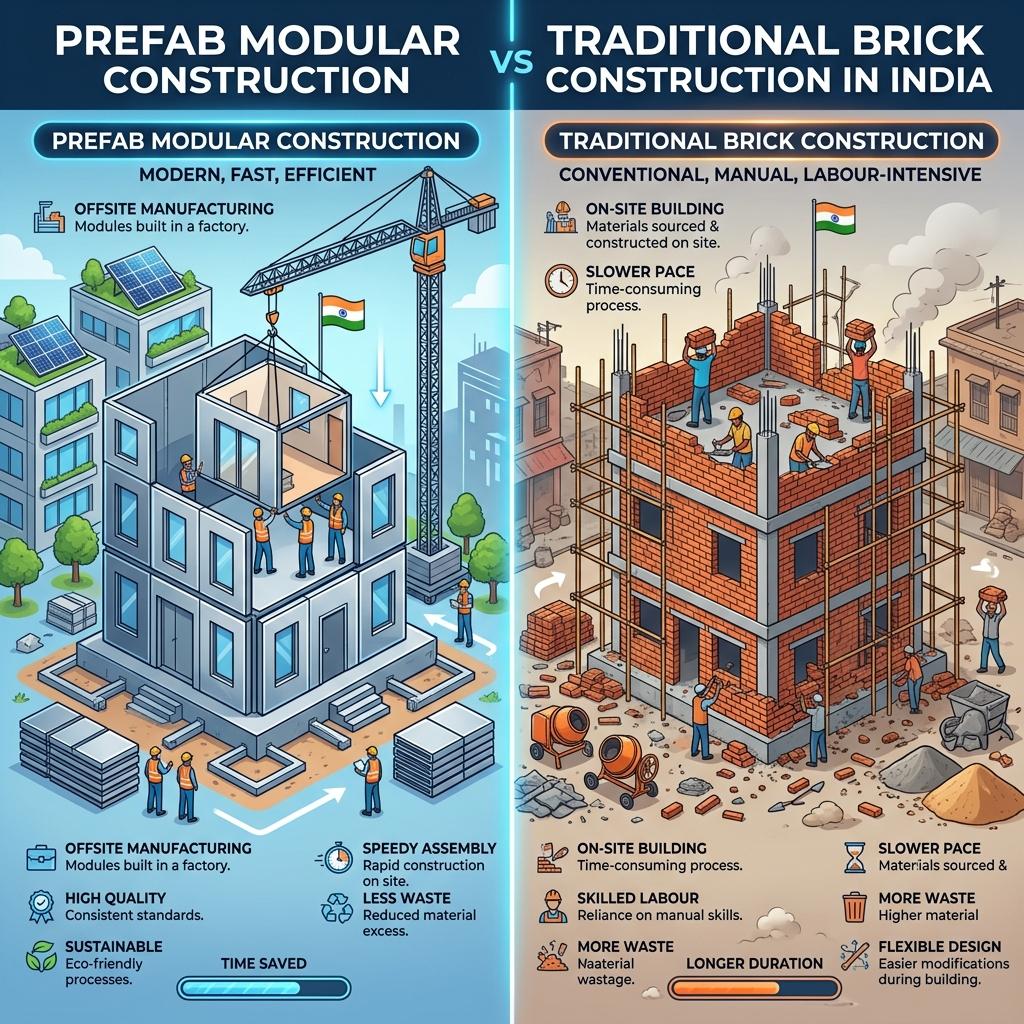
India faces a housing shortfall of nearly 18.78 million units (Ministry of Housing data). Traditional construction simply cannot keep up with this demand , it's too slow, too expensive, and too labour-intensive.
Modular prefab homes offer a compelling solution that's gaining rapid momentum across India. Here's why they represent the future of affordable housing.
What is a Modular Home?
A modular home is a residential structure built in sections (modules) in a factory, then transported to the plot and assembled on a prepared foundation.
Unlike mobile homes (which are permanent residents on wheels), modular homes:
- Are assembled on a permanent or semi-permanent foundation
- Meet or exceed local building code standards
- Look and function identically to site-built homes
- Can be 1, 2, or even 3 storeys
The Affordable Housing Problem in India
India's urban housing crisis is acute:
- Average land + construction cost for a 600 sq. ft. apartment in a Tier 1 city: ₹25–₹60 lakh
- Monthly EMI on ₹40L loan at 8.5%: ₹35,000+
- Average monthly income of urban worker: ₹18,000–₹30,000
The math doesn't work for millions of Indians. Modular homes change this equation.
Why Modular Homes Are More Affordable
1. Factory Efficiency = Lower Material Cost
Factory production means:
- Bulk purchasing of materials at wholesale rates
- Zero material wastage (factory precision vs. site estimates)
- Fewer skilled workers needed per unit built
Savings: 25–40% on materials
2. Faster Construction = Lower Labour Cost
A modular home is assembled in 2–8 weeks on-site. Traditional construction for the same footprint takes 8–18 months.
Labour cost savings: 30–50%
3. No Weather Delays
Rain, heat, and dust don't stop a factory. Traditional construction in India is heavily disrupted during monsoon (June–September) , 4 months of potential delays built into every traditional project.
Zero weather delay savings: significant
Quality That Rivals Traditional Construction
Modern modular homes use:
- Galvanized steel or light-gauge steel frames , stronger than traditional wooden frames
- SIPs (Structural Insulated Panels) or MS panels for walls
- Factory QC , every joint, weld, and seal inspected before leaving the factory
- Thermal insulation , better energy efficiency than most site-built homes
Result: Homes that are warmer in winter, cooler in summer, and more energy-efficient than comparable traditional builds.
Environmental Advantages
| Factor | Modular | Traditional | |--------|---------|-------------| | Material waste | 5–10% | 25–35% | | Site dust/pollution | Minimal | Significant | | Energy use in build | Lower | Higher | | Post-life recyclability | Steel: 100% | Concrete: 30% |
Use Cases for Modular Homes in India
Weekend Farmhouses
Land outside cities is affordable; building cost is the barrier. A modular farmhouse can be installed in 3–6 weeks on your plot , at half the cost of traditional construction.
Starting from ₹8–₹15 lakh for 400–800 sq. ft.
Rural Housing Schemes
Government's PMAY scheme and similar state programs are increasingly specifying prefab construction for speed and cost-effectiveness.
Disaster Relief Housing
Post-flood and post-earthquake reconstruction using modular units: fast, safe, dignified housing deployed in weeks, not years.
Affordable Urban Worker Housing
Factory workers, construction labourers, and migrant workers living in unhygienic jhuggi settlements can be rehoused in modular labour colonies , a permanent, dignified solution.
Is a Modular Home Legally Approved in India?
Yes , modular homes can receive planning approval in India, subject to local building bylaws.
Key considerations:
- Foundation , a concrete raft or pile foundation is typically required by municipal authorities
- Building permit , same process as traditional construction; submitted drawings include structural engineer's certificate
- IS standards , steel must conform to IS 2062; structural design to IS 800
- Structural certificate , issued by the modular home manufacturer
Most reputable manufacturers (including S Porta Offices) provide full structural drawings and engineering certificates for building permit applications.
Modular vs. Traditional: Total Cost of Ownership
For a 600 sq. ft. modular home in Delhi NCR:
| Cost Head | Modular | Traditional | |-----------|---------|-------------| | Construction cost | ₹8–₹12L | ₹15–₹22L | | Timeline | 6–10 weeks | 10–18 months | | Monthly running cost | Lower (better insulation) | Higher | | End-of-life value | Steel recycled at ~60% | Near-zero demolition value |
Total lifetime savings: ₹8–₹15 lakh per home
S Porta Offices , Modular Homes Delivered Across India
We manufacture premium modular farmhouses and weekend homes for Indian conditions:
- ✅ MS-insulated walls and roof , summer-ready
- ✅ Full electrical and plumbing provisions
- ✅ Custom interiors , from basic to fully furnished luxury
- ✅ Structural engineer's certificate included
- ✅ Pan-India delivery and installation
- ✅ 1-year workmanship warranty
Popular configurations:
- 1BHK Farmhouse: 400 sq. ft. , from ₹7.5 lakh
- 2BHK Farmhouse: 700 sq. ft. , from ₹13 lakh
- 3BHK Farmhouse: 1,000 sq. ft. , from ₹19 lakh
📞 Call: +91-6394362346
🔗 Explore Modular Homes: amoffices.in/products/farmhouse